
Published in: REMEVET, 6th Edition · Presented for CVDL Florida 2026 · Technical review.
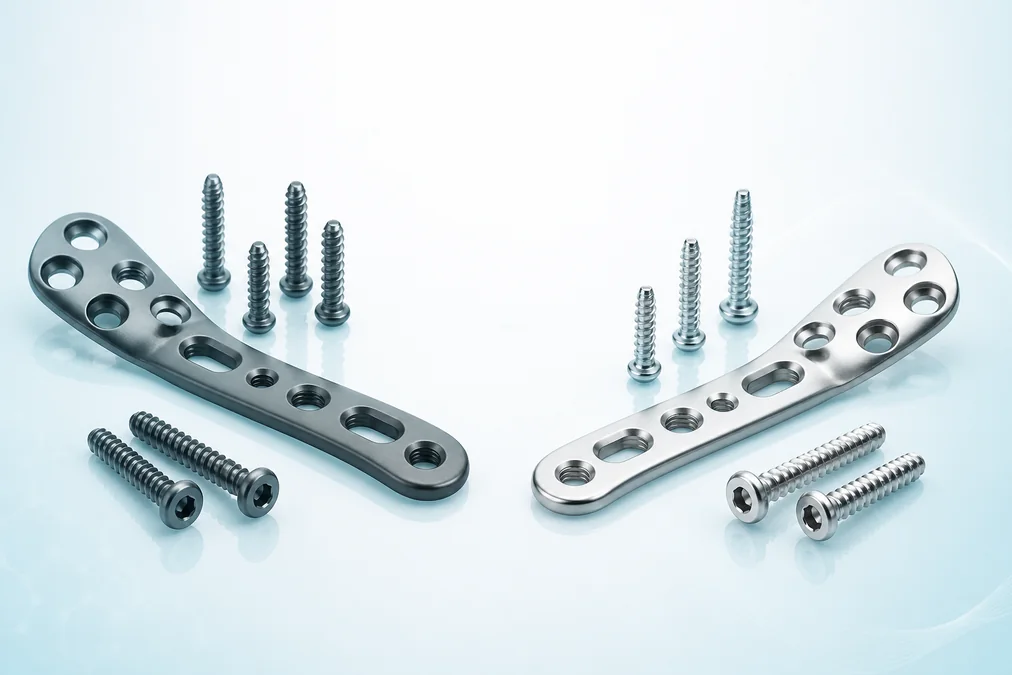
Material selection influences the mechanical behavior, handling and long-term performance of an orthopedic implant. This practical review compares two widely used implant alloys—medical-grade titanium 6Al-4V ELI and stainless steel 316LVM—and explains where their different properties matter in veterinary fracture fixation.
Key differences for orthopedic applications
- Weight: titanium has a substantially lower density, allowing lighter implants of comparable geometry.
- Strength-to-weight ratio: titanium combines high mechanical strength with low mass.
- Elastic modulus: titanium is less stiff than stainless steel and more closely approaches the behavior of cortical bone, an important consideration in load sharing.
- Corrosion resistance and biocompatibility: the stable oxide layer on titanium supports excellent resistance in physiological environments.
- Manufacturing and cost: stainless steel remains economical, familiar and comparatively easy to machine.
Clinical interpretation
Neither alloy replaces sound case planning. Implant geometry, working length, screw distribution, patient weight, activity, bone quality and the biological environment all remain essential. The material should be selected as one component of the complete fixation strategy.
This educational article was prepared by Juan Sebastian Silva, Javier Castañeda, Cesar Silva and David Silva and presented in the sixth edition of the REMEVET CVDL Florida magazine.
Read the complete REMEVET CVDL Florida 2026 edition.
For veterinary professional education. Product choice and surgical planning should be based on the individual patient and the treating surgeon’s clinical judgment.